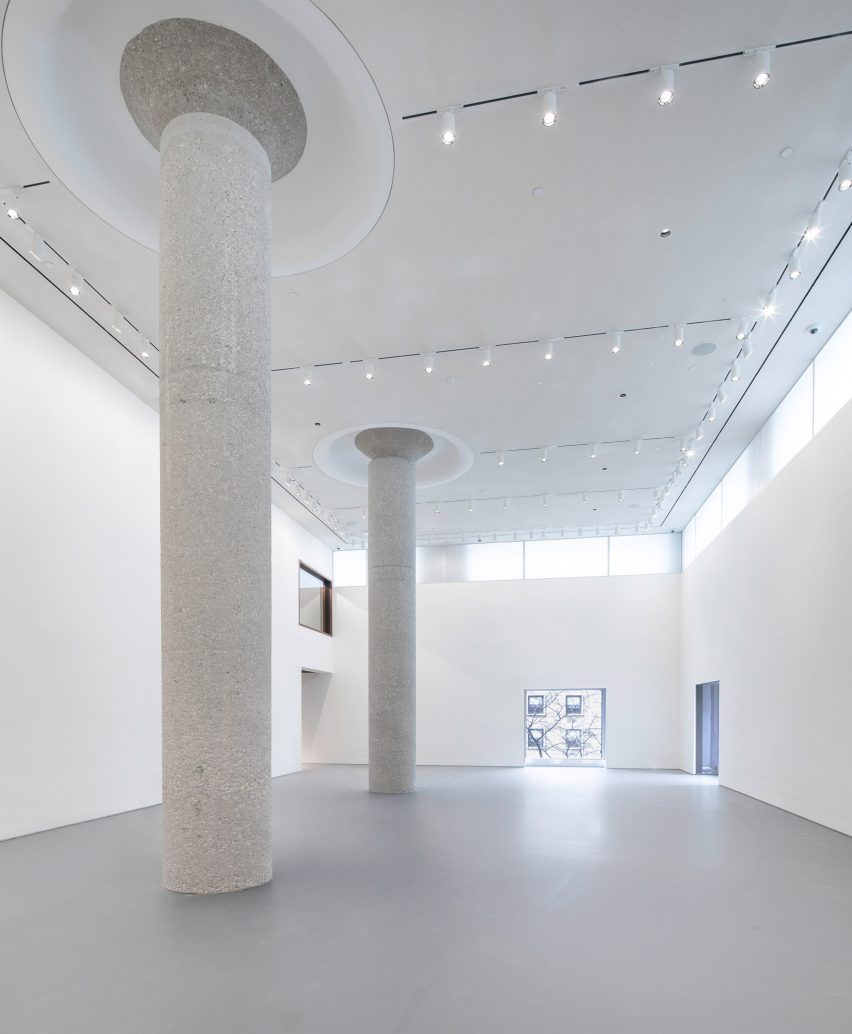
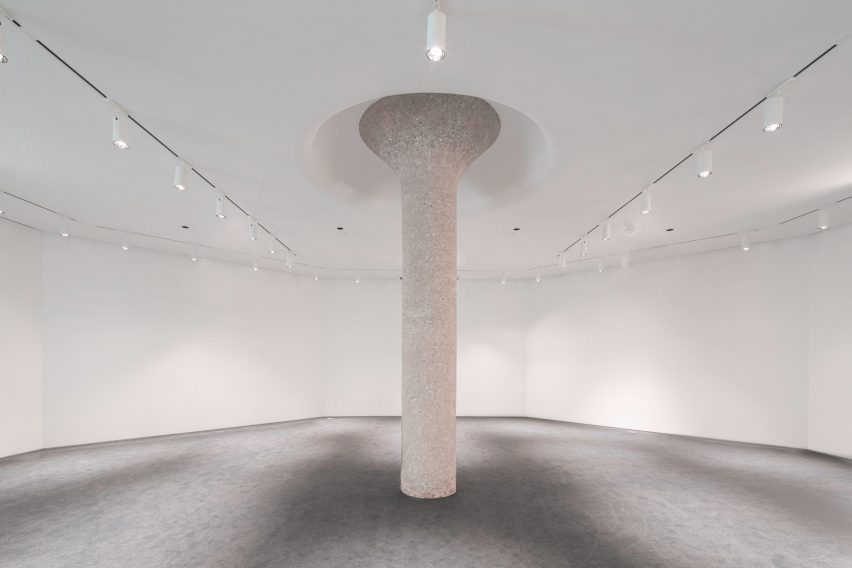
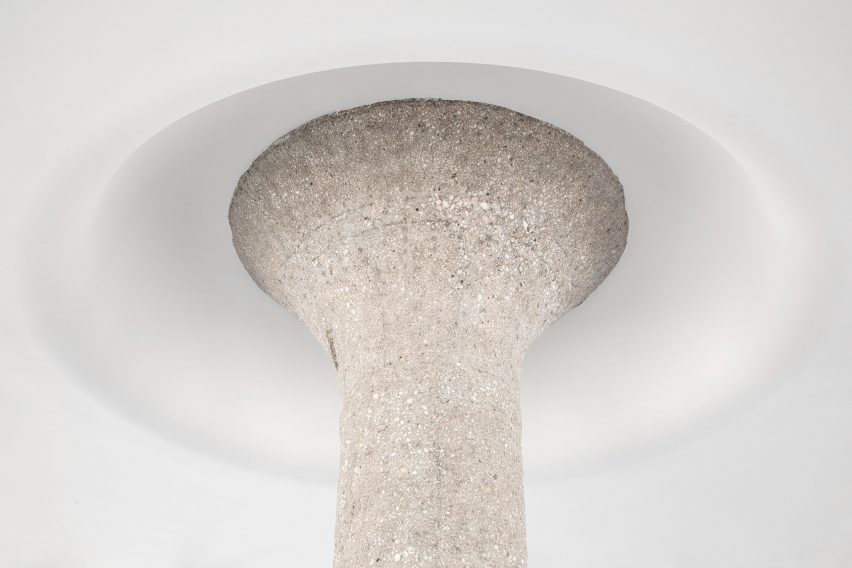
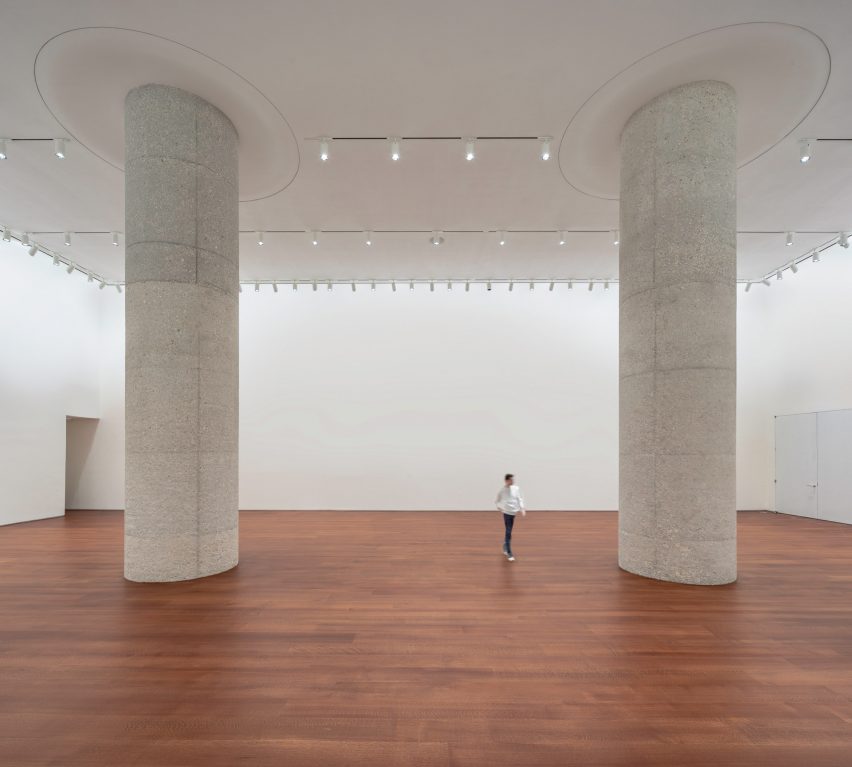
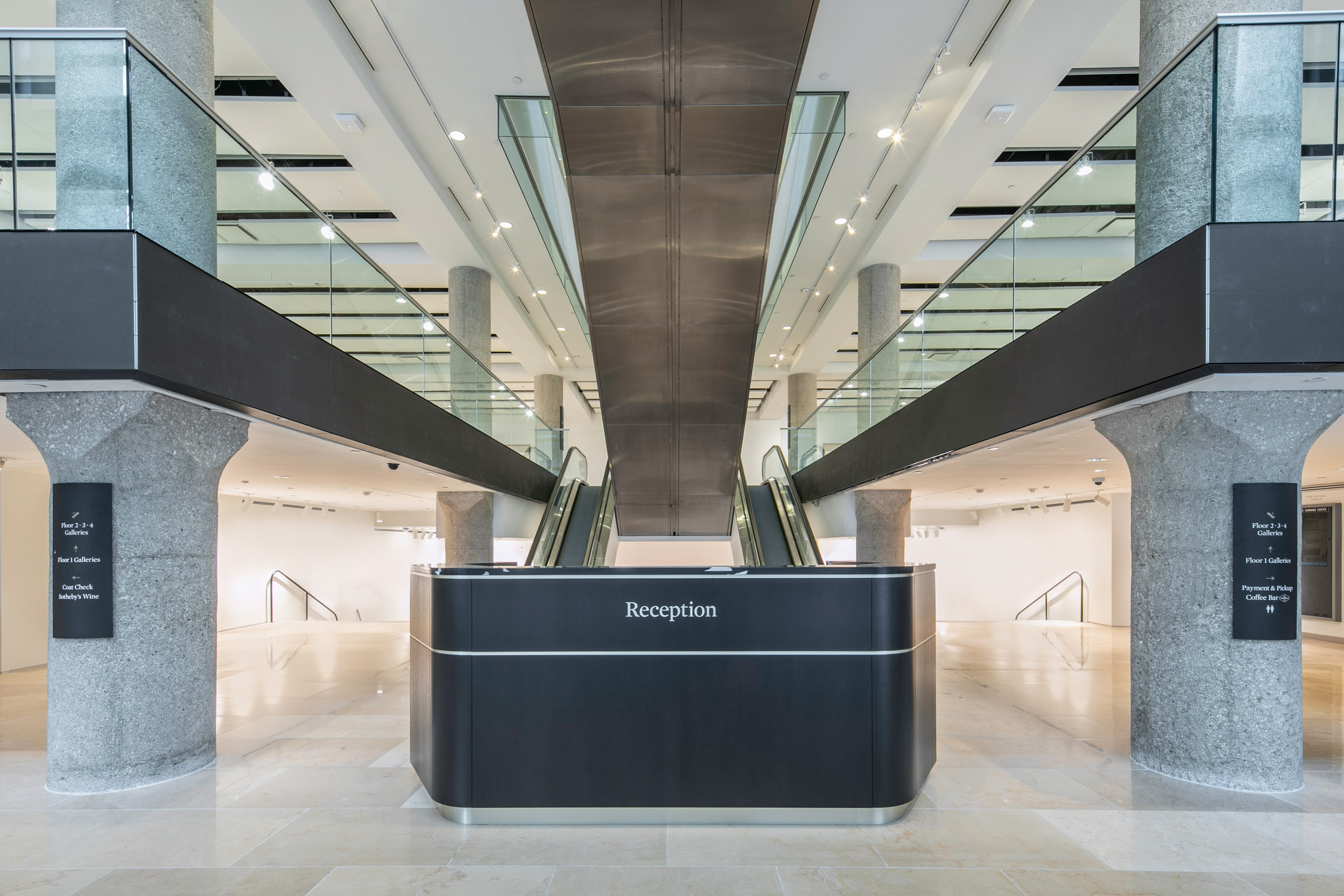
Chunky columns covered in aggregate puncture through galleries in Sotheby’s New York headquarters, which has just re-opened to the public following a major overhaul designed by OMA partner Shohei Shigematsu.
Shigematsu led OMA’s New York outpost on the update of the international auction house‘s headquarters. Unveiled earlier this year, the scheme focused on “surgically restacking and consolidating” four floors in the Manhattan headquarters to increase exhibition space and public programming.
The headquarters – which opened to the public on 3 May following a brief closure – now features over 20,000 square foot (1858 square metres) of extra exhibition spaces and 40 public galleries in varying shapes and sizes.
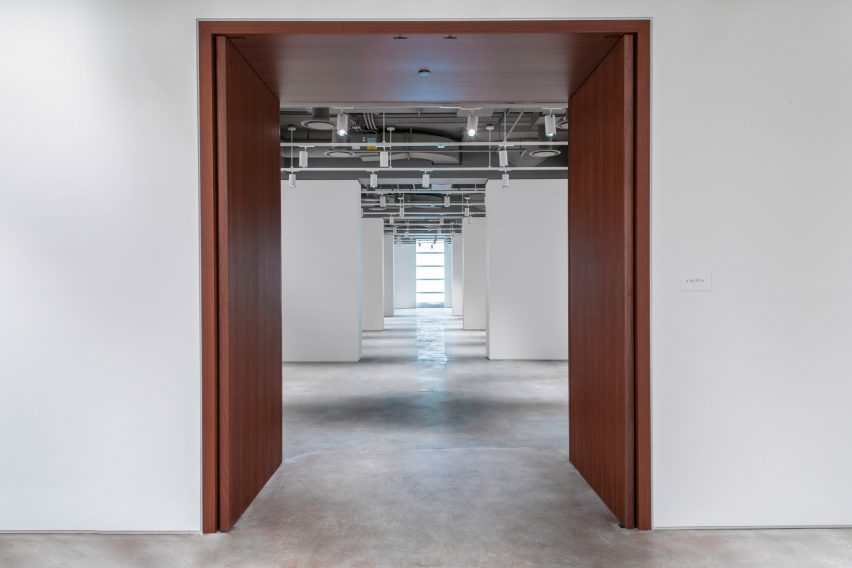
“A dynamic repertoire of spatial conditions for display – from white cube, double height, enfilade, corridor, cascade, octagonal and L-shaped – can be used individually or as clusters, to accommodate various programming as well as the display of Sotheby’s diverse portfolio,” said OMA in a statement.
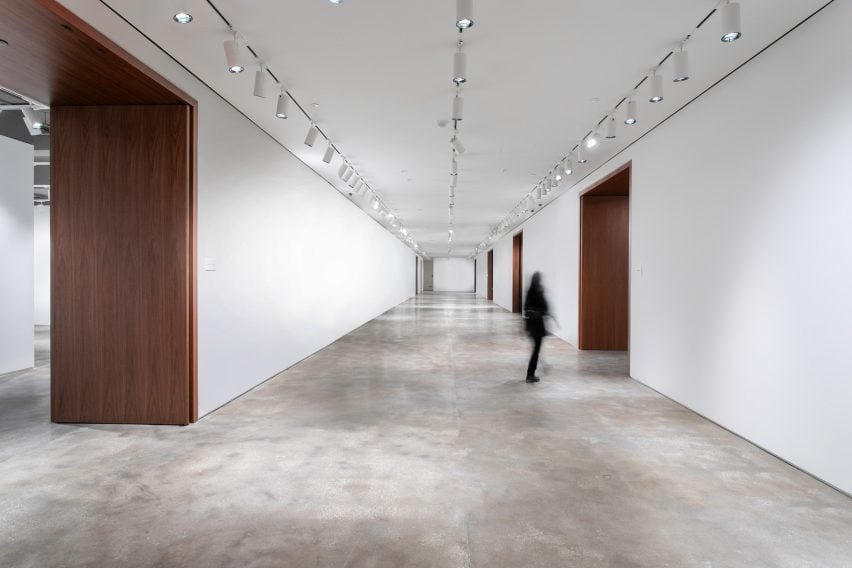
Among the new spaces is the Enfilade Galleries, which comprises four galleries of exactly the same size set side-by-side; a series of “domestically scaled” areas for furniture, design and collections; and a 150-foot-long (46-metre) Grand Gallery for showcasing a full collection.
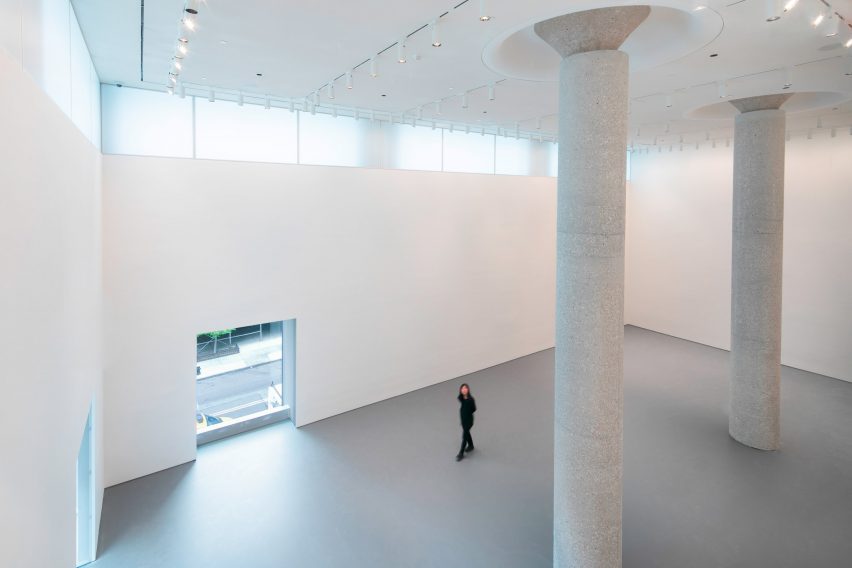
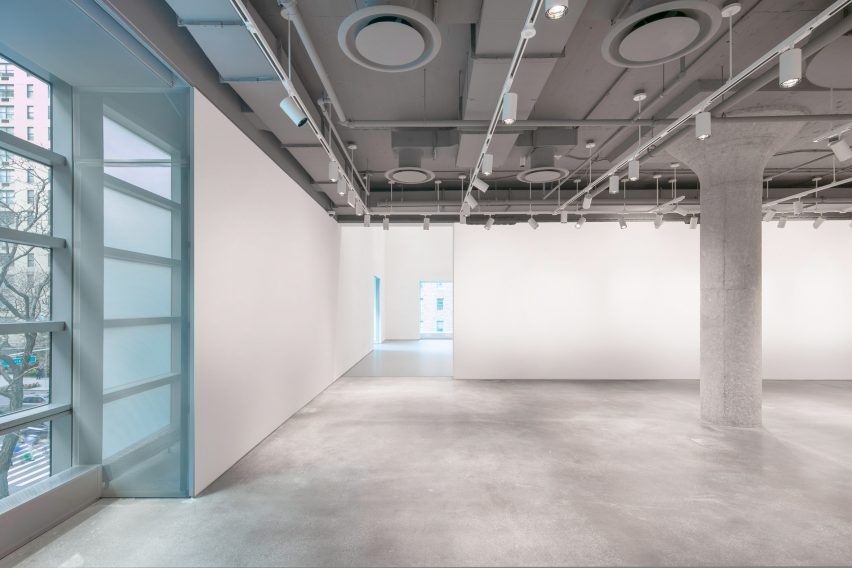
The firm’s main intervention, however, was the creation of a double-height space on the ground floor for exhibiting large sculptural works. A window punctures one of the upper walls so that pieces can also be viewed from the exhibition space on the first floor.
White-painted walls and a mix of flooring, including dark wood and exposed concrete, offer a simple aesthetic and plain backdrop to provide a suitable backdrop for works.
The pared-back decor also complements a number of existing details preserved during the project, such as ceiling structures and the thick existing columns. A number of these were stripped back to reveal the aggregate below, while others were reinforced with extra aggregate.
“The history of the building at York Avenue is not ignored,” said OMA.
“Existing concrete columns are exposed, stripped, and hand stippled to reveal their material character, and steel beams in open ceiling galleries are left exposed, acknowledging the building’s industrial past,” it added.
Custom-stained walnut panels and doors provide connections between different rooms and are intended as a nod to the woodwork detailing found at Sotheby’s London headquarters.
Shigematsu also wanted to open up views between the gallery and the street corner. In response, he created a number of large openings in the building’s gridded exterior, which he likens to an Excel sheet.
Sotheby’s New York opened last week to coincide with the launch of its exhibitions and auctions of Impressionist & Modern and Contemporary Art.
Headquartered in New York, the company completed the overhaul as part of wider update to its global offerings. OMA’s project follows renovations to Sotheby’s in London and Paris, and the opening of new hubs in Geneva, Dubai and Tel Aviv.
Shigematsu runs OMA New York with partner Jason Long. The practice functions independently from the other international offices, including Rotterdam, Beijing, Hong Kong, Doha and Australia, as part of an initiative established by founder Rem Koolhaas.
There are loads of great benefits to properly onboarding each new member onto your platform. This post will cover those benefits, and the components of a good onboarding strategy.
What is an Onboarding Strategy?
An onboarding strategy is a series of steps for welcoming a person into some kind of group or organization.
If you’ve ever started at a new company, you’ll recall your first few days in which you were shown were everything was, how to use their systems, and generally, how you’d go about carrying out your new job.
In some companies, this is a full-on training course that could last more than a week.
Similarly, in onboarding for your membership site, you need to show new subscribers where everything is, how to best find their way around, and where they can find help if they need it.
This could be achieved via a series of emails, videos, a webinar, or a comprehensive Getting Started guide.
Benefits of an Onboarding Strategy
Make New Members Feel Welcome
By taking new subscribers to your site by the hand and showing them around, you’re making them feel welcome.
This reaffirms that they’ve made the right choice and it’s less likely that they’re going to end their subscription prematurely.
In other words, a good onboarding process will increase your member retention rate over time.
Alternatively, merely leaving newbies to figure out your platform for themselves is more likely to result in them become lapsed members.
There’s no guarantee they’ll find the best features your platform has to offer on their own.
Save Time in the Long Run
If you take the time to show new members where things are, they’re less likely to ask you later.
Granted, some, if not many, people will still contact you to ask you for help with something simple, but you’ll have avoided scores more questions by providing a quick tour first.
This approach is also more empowering for your members: while some people seek assistance as soon as they’re remotely stumped, others prefer not to ask for help.
By giving them the means to figure things out for themselves, you’ll save time and effort, and so will they.
Continued Interaction
An onboarding strategy gives you a good reason to stay in contact with your members.
This could be through a series of emails, detailing the next part of the process, or a feature of your website that you wish to highlight.
As well as further demonstrating the value of your platform, you’ll be displaying your personal value to them too.
This is especially important if they’ve joined your site on a free trial, as they’re still prospects at this point – your work is not yet done!
However, even if this is not the case, having your members being accustomed to hearing from you is handy, particularly if you plan on launching other products or services in the future.
Birders who reside in the Northern Hemisphere know that late April and early May offer some of the best birding of the year as summer songbirds return to their breeding grounds. Here along the Colorado Front Range, that annual parade is well underway.
Over the past week, broad-tailed hummingbirds and house wrens have returned to our Littleton farm and, down at South Platte Park, I have recently observed barn and violet-green swallows (joining their tree cousins), brown-headed cowbirds, white-crowned sparrows and a green-tailed towhee; Swainson’s thrushes, blue-gray gnatcatchers, chipping sparrows, gray catbirds, Lazuli buntings and Bullock’s orioles should arrive any day now. The number of migrant yellow-rumped warblers has been increasing on a daily basis and other Western warblers and flycatchers are expected within the next two weeks.
All of these summer species will be greeted by our next round of chilly rain and snow early next week but they “know” Colorado and always adapt well. We birders certainly appreciate the seasonal message that they bring, especially during the fickle weather of a Front Range April.
BMW is gearing up for the India bound fourth-generation new BMW X5 which will be launched this month. Based on the Cluster Architecture (CLAR) platform which incorporates steel, aluminium and carbon fibre. The new platform not only makes the car lighter but now also comes with air suspension on all four corners and a four-wheel drive steering.
ENGINE AND TRANSMISSION:
The SUV will pack a 3.0L, turbocharged 6 cylinder diesel engine which will churn out 265bhp of power with a peak torque of 620Nm. It will be mated to an 8-speed Automatic gearbox. It is smooth and effective. We can expect a BS-VI compliance engine that will go with the standards of Indian emission norms.
EXTERIORS
The exteriors now look grand and well appeared as the newer generation packs a large kidney grille and new LED Headlamps. Moving to the sides, the car looks packs angular lines and notable shoulder line. The rear tail lamps have now grown little in size but looks plain and has a horizontal design.
FEATURES & INTERIORS
Following the latest dashboard design which is already seen on the 7 series and 5 series, the new BMW X5 now gets two 12.3-inch displays. One sets up in the centre console and other that makes up for instrument cluster. It gets the iDrive 7.0 which allows the driver to control the screen by touch inputs which makes it a quick process. Wireless charging will be an optional feature and expect a large panoramic sunroof with sky lounge features that we have in the 7-series.
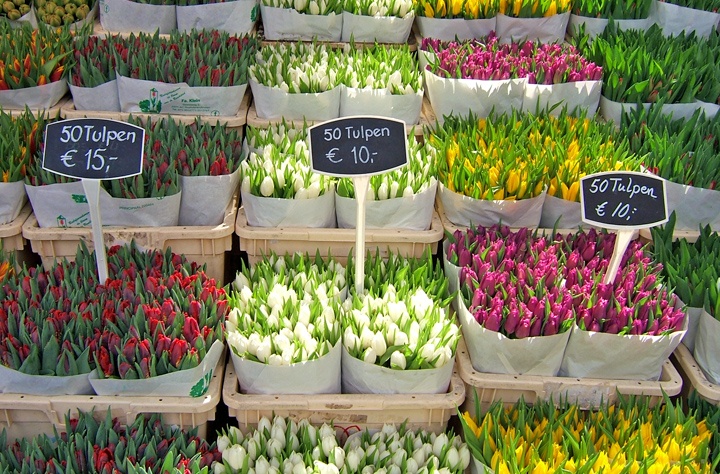
A city of 1500 bridges, 50km of canals and more bikes than people, Amsterdam is one of Europe’s most popular cities with visitors from around the world. Along with its beautiful gabled houses and flower-decked watersides, there’s an enormous amount to see and do, whether your interests are more Golden Age art or graffiti, high culture or getting high in a coffee shop. But this wealth of amazing experiences doesn’t have to come with a huge price tag attached to it. So here are my top tips for making the most of Amsterdam on a budget.
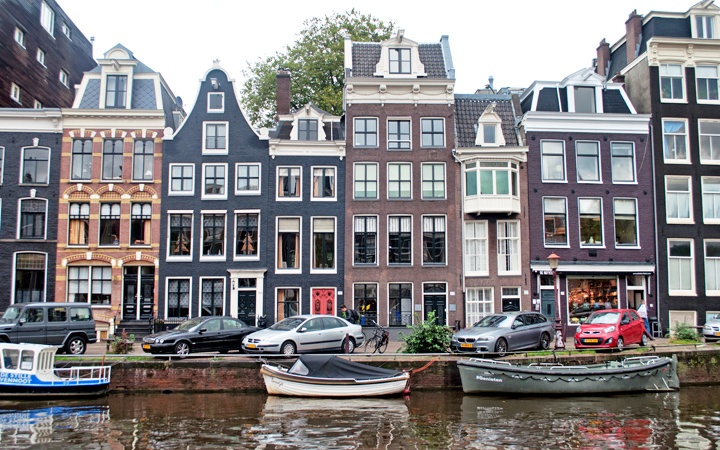
Amsterdam is synonymous with its canals, and one of the best free things to do in the city is get out and get lost among them. The city is centred around the UNESCO-listed Canal Ring, where three canals form a horseshoe shape around the old centre.
Beyond that there’s Jordaan, a former working-class area now full of galleries, restaurants and boutiques among some of the prettiest stretch of canal. Or hang out in the cafés of De Pijp, a district with a young, creative feel that’s is home to the Albert Cuypmarkt street market. You can also visit the Jewish Quarter for the Waterlooplein flea market, zoo and botanical gardens.
If you want a break from canals, the city also has some lovely parks – ranging from the huge Vondelpark (which hosts free events in its open-air theatre on weekends from May to September) to the peaceful Begijn of, a pretty courtyard surrounded by 14th-century cottages.To learn a bit about the city’s history, several companies run free walking tours where you just tip your guide. Sandeman’s New Amsterdam Tours do a 3-hour city highlights tour leaving from the National Monument in Dam Square several times a day. Original Amsterdam Tours run a 3-hour city history walk and an ‘Alternative Amsterdam’ tour of street art, coffee shops and squats in some of the city’s lesser-known areas. Both depart opposite Madame Tussauds at 2pm.
Or the I Amsterdam card gives you free entry to over 60 museums and attractions, plus a free canal cruise and unlimited public transport on the trams, buses and metro. There are four different versions: 24 hours (€59), 48 hours (€74), 72 hours (€87) and 96 hours (€98).
For a free taste of culture, head to the Schuttersgalerij or Civic Guards Gallery, where 15 Goldern Age paintings, similar in style to Rembrandt’s Night Watch, line a covered street near the Amsterdam Museum. In a modern building on the riverside, the EYE film museum has a free basement cinema and private viewing pods. It’s free to get there too on the Buiksloterweg ferry from behind Centraal Station. Other free museums include the City Archives, Multatuli Museum and the Hollandsche Schouwburg (Holocaust Memorial).
A city of 1500 bridges, 50km of canals and more bikes than people, Amsterdam is one of Europe’s most popular cities with visitors from around the world. Along with its beautiful gabled houses and flower-decked watersides, there’s an enormous amount to see and do, whether your interests are more Golden Age art or graffiti, high culture or getting high in a coffee shop. But this wealth of amazing experiences doesn’t have to come with a huge price tag attached to it. So here are my top tips for making the most of Amsterdam on a budget.
Amsterdam is synonymous with its canals, and one of the best free things to do in the city is get out and get lost among them. The city is centred around the UNESCO-listed Canal Ring, where three canals form a horseshoe shape around the old centre.
Beyond that there’s Jordaan, a former working-class area now full of galleries, restaurants and boutiques among some of the prettiest stretch of canal. Or hang out in the cafés of De Pijp, a district with a young, creative feel that’s is home to the Albert Cuypmarkt street market. You can also visit the Jewish Quarter for the Waterlooplein flea market, zoo and botanical gardens.
If you want a break from canals, the city also has some lovely parks – ranging from the huge Vondelpark (which hosts free events in its open-air theatre on weekends from May to September) to the peaceful Begijnhof, a pretty courtyard surrounded by 14th-century cottages.
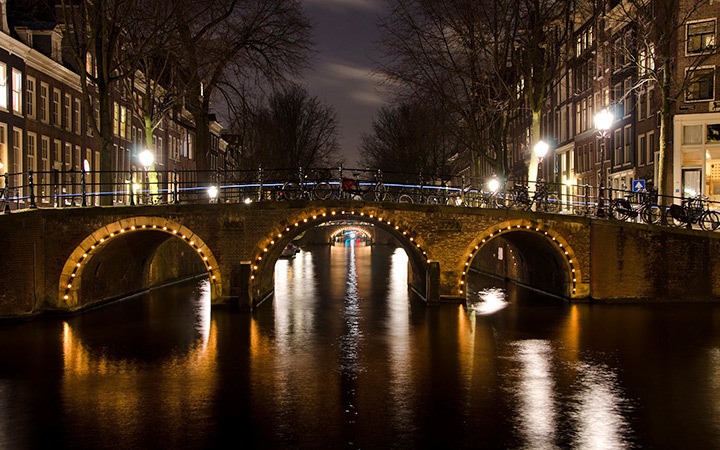
Amsterdam bridge
To learn a bit about the city’s history, several companies run free walking tours where you just tip your guide. Sandeman’s New Amsterdam Tours do a 3-hour city highlights tour leaving from the National Monument in Dam Square several times a day. Original Amsterdam Tours run a 3-hour city history walk and an ‘Alternative Amsterdam’ tour of street art, coffee shops and squats in some of the city’s lesser-known areas. Both depart opposite Madame Tussauds at 2pm.
For classical music fans, there are free half-hour lunchtime concerts at the Concertegebouwconcert house at 12.30pm on Wednesdays (mid-September to June). Some feature the full orchestra rehearsing and others have young musicians. There are also similar concerts on Tuesdays at 12.30pm (September to May) in the foyer of the Dutch National Opera and Ballet.
Or if you prefer jazz, the Bimhuis venue at the Muziekgebouw holds free Monday Match improvisational evenings at 8.30pm on the first Monday of the month and weekly Tuesday workshops at 8pm (where any musicians can join in) followed by a 10pm jam session.
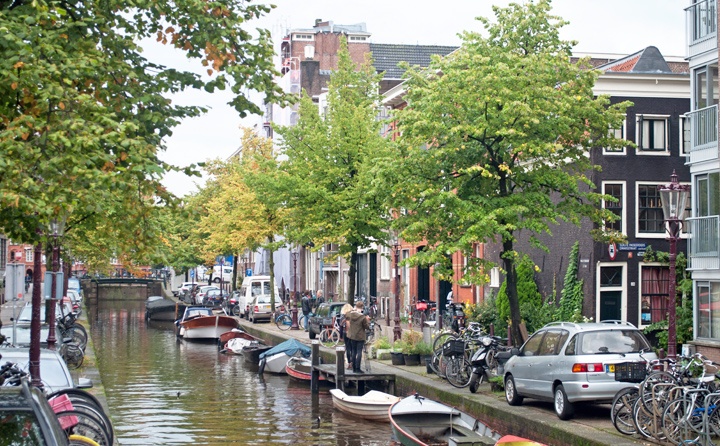
Along the canals in Jordaan
Money Saving Places
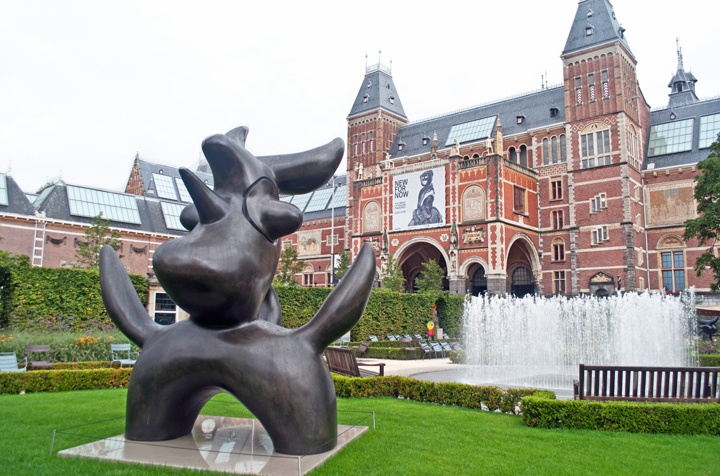
Entry to Amsterdam’s big-name museums – like the Rijksmuseum, Van Gogh Museum and Stedelijk modern art museum – costs around €18 per person (entry is free for under 18s). Though you can check out the sculpture gardens surrounding the Rijksmuseum for free.
You can book museum tickets online in advance, which won’t save you money but will help you skip the ticket queue. It’s an especially good idea at the Anne Frank House as you get a timed entry slot that lets you can bypass the long queues that often stretch right down the street (entry costs €10 for adults, €5 for children 10-17 and free for under 10s).
If you’re planning on visiting a lot of museums, there are a couple of discount cards available which can save you money. The Amsterdam City Pass costs €56 for adults (€24 for children 13-17 and €18 for 4–12s) and includes skip-the-line access to the Rijksmuseum and the Van Gogh Museum, as well as a canal cruise and tickets for the airport train.
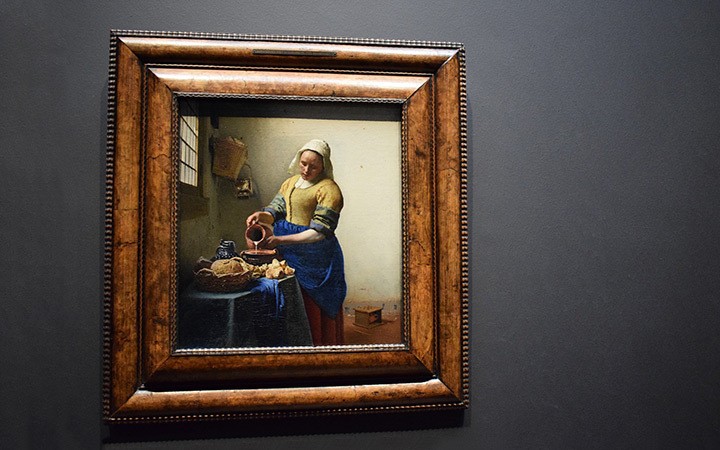
Rijksmuseum artworks
Or the I Amsterdam card gives you free entry to over 60 museums and attractions, plus a free canal cruise and unlimited public transport on the trams, buses and metro. There are four different versions: 24 hours (€59), 48 hours (€74), 72 hours (€87) and 96 hours (€98).
For a free taste of culture, head to the Schuttersgalerij or Civic Guards Gallery, where 15 Goldern Age paintings, similar in style to Rembrandt’s Night Watch, line a covered street near the Amsterdam Museum. In a modern building on the riverside, the EYE film museum has a free basement cinema and private viewing pods. It’s free to get there too on the Buiksloterweg ferry from behind Centraal Station. Other free museums include the City Archives, Multatuli Museum and the Hollandsche Schouwburg (Holocaust Memorial).
In the sculpture garden at the Rijksmuseum
TOP CITY VIEWS
The centre of Amsterdam is fairly low rise, so you won’t find any skyscrapers with views from up high. There are some good city viewpoints though, like from the top of the Openbare Bibliotheek(Public Library). It’s free to enter and there is a café and restaurant with an outdoor terrace.
You can also get a drink with a view from the 11th floor bar in the DoubleTree hotel on Oosterdokstraat (open 11am–1am, or 3am on Friday/Saturday). Or across the city there’s the Hotel Okura which has a cocktail bar on its 23rd floor that’s open to non-residents (open 6pm–1am, or 2am on Friday/Saturday). There’s also Cafe Blue on top of the Kalvertoren shopping centre, with floor-to-ceiling windows and a 360 degree panoramic view. It’s normally open from 10am–6.30pm but stays open until 9pm on Thursday nights.
I always get a little bit of anxiety when I am asked to go out to eat with friends and family. Those who have strict nutrition and health goals can probably relate to this stress. However, going out to eat doesn’t necessarily mean that you are doomed to fall off the wagon. Today, I’m going to share some tips on how to make healthy choices when at restaurants, because YES, you deserve to be social and to have a good time with friends! You CAN have the best of both worlds.
1.) Practice portion control
Restaurant portion sizes are completely ridiculous, and it can be hard not to physically eat everything that is front of us on our plate. In fact, most portions are fit to feed 2-3 people instead of just one person. This is why it is very important to be mindful about the quantity of food that is right front of you. A great rule of thumb is to only eat half of what is served to you on the plate, or to order an appetizer instead of a main.
2.) Opt for lots of veggies
You can never eat too many veggies!! Choose an entrée that is filled to the brim with veggies. Examples may include veggie breakfast skillets, salads, fajitas, veggie flat breads, chicken with a side of veggies, or omelets. Veggies are full of fiber and they also keep our blood sugar down, so we are less likely to want to indulge in the delicious high calorie foods.
3.) Snack on something high-protein BEFORE you go out to eat
Before I head out, I like to snack on something high protein before I meet up with friends. This way, I am not starving when I am at the restaurant; hence I am less likely to order something unhealthy off the menu and eat errrrything in plain sight. This trick has really helped me practice my portion control! My favorite protein-filled snacks include hard-boiled egg whites, protein bars, or protein shakes. These are easy, low-calorie snacks that are super filling.
4.) Drink a glass of water before your meal is served
This is another great tip that will help you greatly help you practice portion control. Water fills you up and will trick your mind into believing that you are more full than you really are. Also, it’s just a general rule of thumb that you should drink a glass of water before every meal.
5.) Plan out your meal before you get to the restaurant
If you are seriously trying to stick to a nutrition plan or to manage your weight, planning ahead is SO important. I always like to have a set plan of what I’m going to be eating before I get to the restaurant. Most places will have their menu online, making this possible. I find that when I stick to a plan that I made, I am less likely to order something off the menu impulsively.
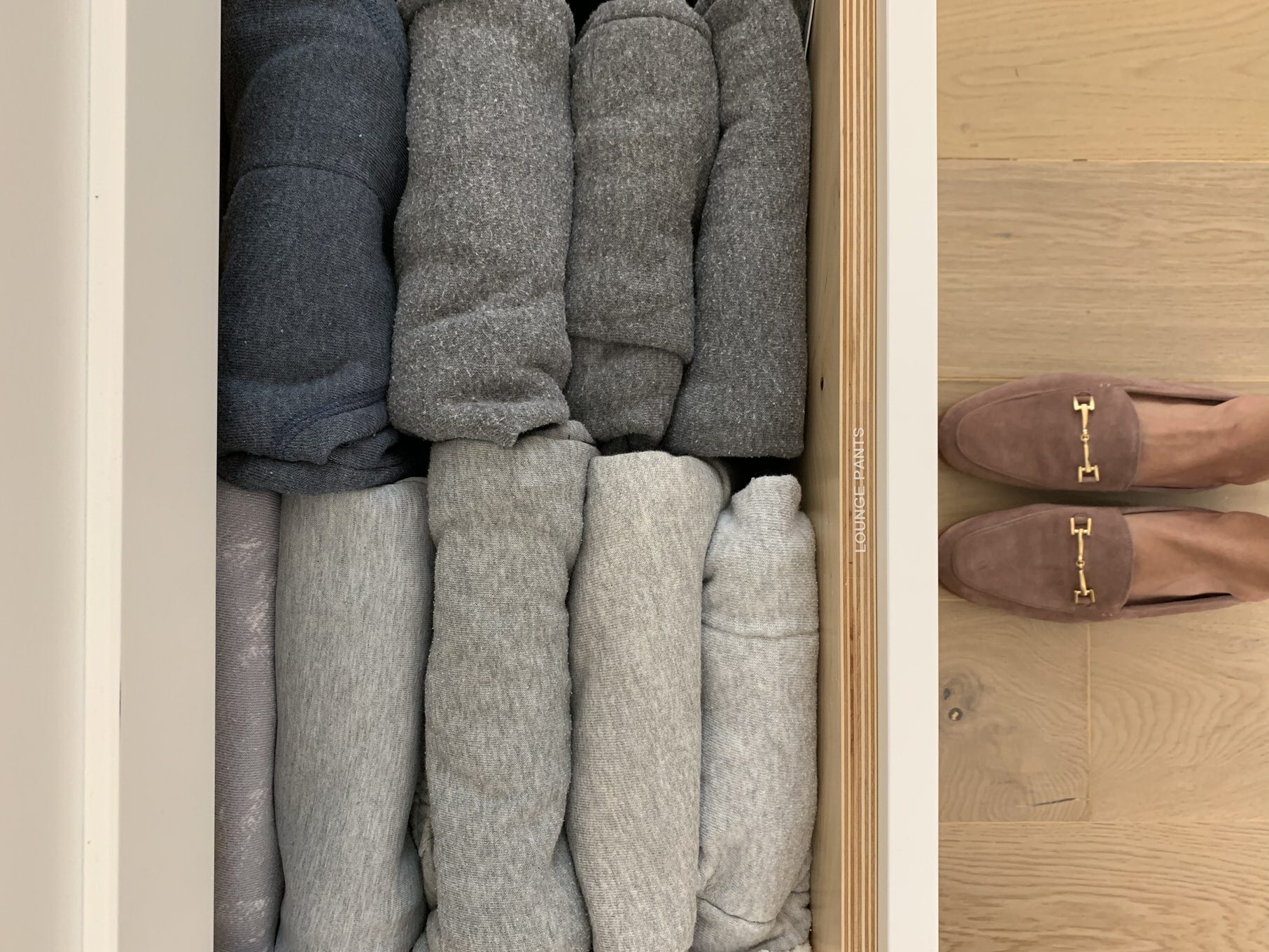
Another trick I learned is to fold all your clothes and stack them all next to each other instead of on top of each other. You’ll be able to see everything in one glance, so you don’t have to go digging at the bottom of any stacks and destroying your piles in the process. It also helps you maximize your drawer space so you are using every corner more efficiently. (I’ve always struggled with pants but actually LOVE how they look folded up this way in the dresser!)
3. Label It: Can I tell you how excited I was to get a label maker!! I opt for over-labeling. I like having it clear so I can’t forget and I just love the way they look! Anyone else?? I labeled all my drawers, the subsections of my drawers, and the storage bins on my top shelves. I knew it would help me be better about putting clothes away right where they go. And for bins that show that you need a bigger label for – these gold label holders are so cute! I used them in our laundry room and love them!
Fashion design is the art of applying design, aesthetics and natural beauty to clothing and its accessories. It is influenced by cultural and social attitudes, and has varied over time and place. Fashion designers work in a number of ways in designing clothing and accessories such as bracelets and necklaces. Because of the time required to bring a garment onto the market, designers must at times anticipate changes to consumer tastes.
Designers conduct research on fashion trends and interpret them for their audience. Their specific designs are used by manufacturers. This is the essence of a designer’s role; however, there is variation within this that is determined by the buying and merchandising approach, and product quality; for example, budget retailers will use inexpensive fabrics to interpret trends, but high-end retailers will ensure that the best available fabrics are used.
Fashion designers attempt to design clothes which are functional as well as aesthetically pleasing. They consider who is likely to wear a garment and the situations in which it will be worn, and they work within a wide range of materials, colors, patterns and styles. Though most clothing worn for everyday wear falls within a narrow range of conventional styles, unusual garments are usually sought for special occasions such as evening wear or party dresses.
Some clothes are made specifically for an individual, as in the case of haute couture or bespoke tailoring. Today, most clothing is designed for the mass market, especially casual and every-day wear are called ready to wear.
OMA completes renovation of Sotheby’s New York galleries